
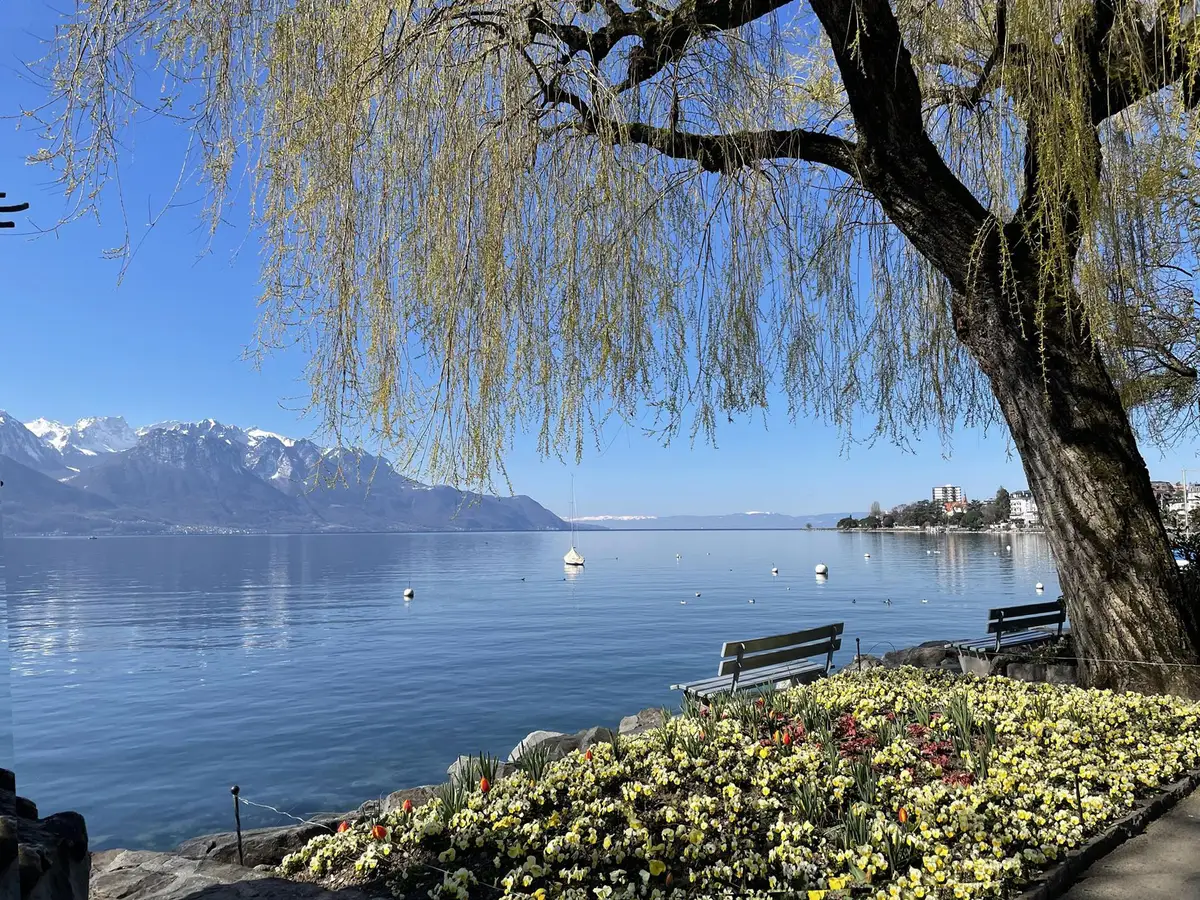
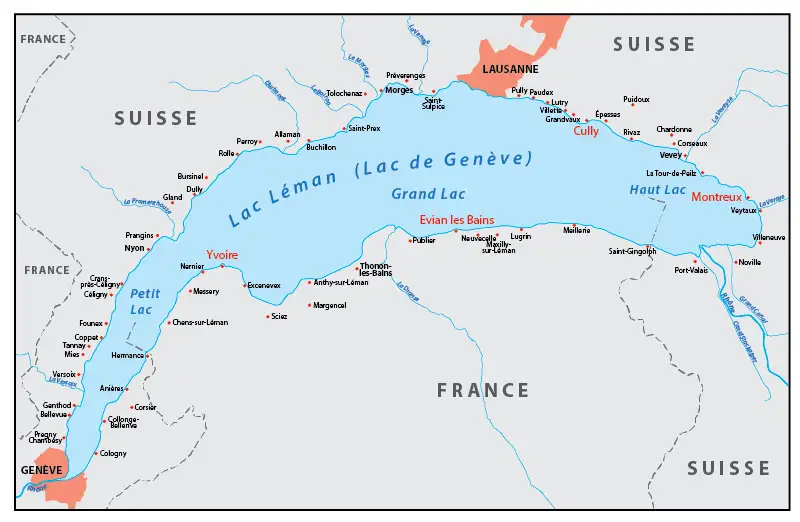
In brief: Lake Geneva is approximately 72.8 km long and up to 13.8 km wide (between Amphion and Morges). It covers nearly 580 km² and reaches a depth of 309.7 m between Évian and Ouchy. Yvoire sits on the headland that separates the Petit-Lac, on the Geneva side, from the Grand-Lac.
Lake Geneva, an “inland sea” between France and Switzerland
Straddling Haute-Savoie (France) and the cantons of Geneva, Vaud and Valais (Switzerland), Lake Geneva is fed mainly by the Rhône (≈ 75% of its inflow), as well as by numerous rivers such as the Dranse, the Aubonne and the Venoge. It formed during the last glacial period, around 16,000 years ago, shaped by glacial erosion and tectonic movements
- Area: approximately 580 km² (345 km² in Switzerland, 235 km² in France)
- Length: 72.8 km – Maximum width: 13.8 km (between Amphion and Morges Bay) – Average width: ≈ 8 km
- Maximum depth: 309.7 m (between Évian and Ouchy) – Average depth: 154.4 m
- Full shoreline: 200.2 km (Switzerland 142.2 km – France 58 km)
- Volume: ≈ 89 km³ – Elevation of the lake: 372 m above sea level
Remarkable nature and biodiversity
- The lake is covered by a Franco-Swiss agreement to protect water quality, even though only 3% of its shores remain in a natural state, while 60% have now been developed (landscaped, paved or privatized).
- The fish fauna is rich: Arctic char, féra (whitefish), perch, pike, lake trout, tench, roach… Arctic char, a fish that requires cool water, is one of the lake’s iconic species. Invasive species are also present, such as catfish, zebra mussels and American crayfish.
- Lake Geneva is a major birdwatching site: swans, pochards, grebes, gulls, herons, cormorants and numerous migratory species that overwinter here provide a constant natural spectacle.
History and human development
- The first traces of human settlement date back to the end of the Upper Paleolithic (Magdalenian), with prehistoric lake-dwelling villages now listed as UNESCO World Heritage Sites.
- The lake’s water level has been regulated since 1884, eliminating seasonal variations and stabilizing its elevation at an average of 372 m (ranging from a high in 1977 to a low in 1949).
- A network of 22 lighthouses around the lake warns boaters of the risk of strong winds or storms, using coded signals according to wind gust intensity.
Activities & things to do
Boating and cruises
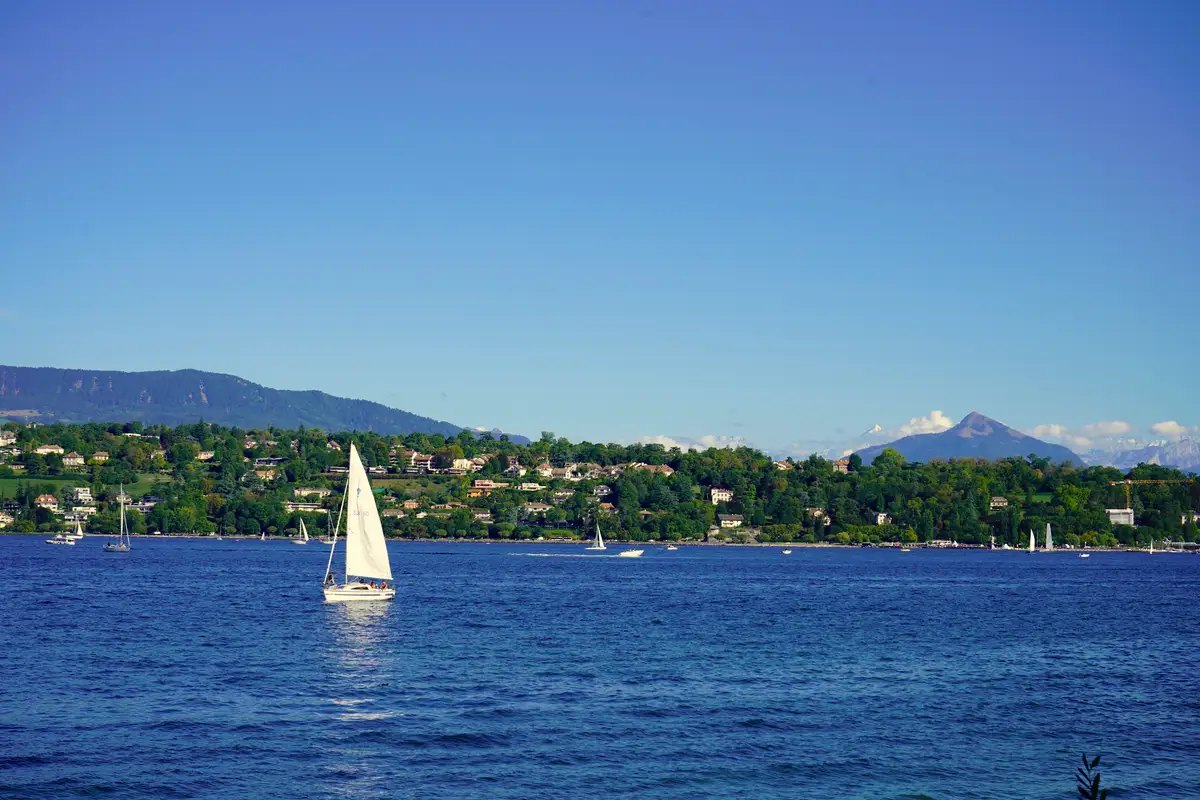
Lake Geneva is an ideal destination for water sports: sailing, stand-up paddleboarding, kayaking, water skiing, wakeboarding, windsurfing and scuba diving are offered by clubs in Geneva, Lausanne, Évian and Thonon. Please note that jet skiing is prohibited.
Walks or boat trips (with the CGN) offer wonderful views of Yvoire from the lake, especially in summer, when you can enjoy the Alpine scenery and the medieval village reflected in the water. The Compagnie des Bateaux du Lac Léman, based in Thonon-les‑Bains, offers cruises departing from the French shore.
Hiking, cycling and nature
- Lakeside trails offer wonderful walks, particularly towards Lavaux (UNESCO-listed vineyards) or Chamonix and Montreux from Geneva. Numerous hiking trails run along Lake Geneva, alternating between views of terraced vineyards (Lavaux, a UNESCO site), mountains and villages such as Yvoire and Nernier.
- The Jardin de l’eau du Pré Curieux (Évian-sur-Léman), accessible by solar-powered boat, captivates visitors with its aquatic vegetation and educational wetlands.
Culture & events
- Montreux and Lausanne bring the music scene to life with jazz festivals and concerts, while Queen set up the famous Mountain Studios there, and Deep Purple wrote “Smoke on the Water,” inspired by the lake and the Montreux casino that burned down in 1971.
- The lake and its region also fuel the imagination: they feature in Tintin – The Calculus Affair, including an iconic scene of a plunge into the lake from Geneva/Nyon.
- Don’t miss the Musée du Léman, near Nyon, with its immersive aquariums and collections of traditional boats, showcasing the history of the lake and its local wildlife.
- On the Swiss side, Geneva and Lausanne offer a wealth of cultural attractions: the iconic Jet d’Eau, the Flower Clock, the Old Town, Saint-Pierre Cathedral, Maison Tavel and the Reformation Wall
Vineyards, gastronomy and heritage
Lake Geneva also delights visitors with its local produce: taste the famous Chasselas in the Lavaux vineyards, explore historic wine cellars or stop at traditional restaurants in Yvoire and Nernier to enjoy fresh lake fish and Savoyard specialties
Beaches near Yvoire
Excenevex, the sandy beach
A few minutes from Yvoire, Excenevex Beach is the only natural fine-sand beach on the French shore of Lake Geneva. Its gentle slope and shallow waters make it a favorite with families. Swimming is supervised in July and August, and dogs, even on a leash, are not allowed on the beach. Behind the beach, the sand dunes are protected under the Natura 2000 program.
Nernier and Rovorée, for a quieter visit
For a wilder setting, the pebble beach at Nernier and the shores of the Rovorée – La Châtaignière estate, between Yvoire and Excenevex, offer a more peaceful swim, away from the summer crowds.
Crossing Lake Geneva from Yvoire
Yvoire is one of the busiest ports on the French shore. CGN boats connect Yvoire with Nyon, in Switzerland, year-round in about 20 minutes; some crossings stop at Nernier. From April to September, services also run to Geneva (about 1 hour 30 minutes) and Lausanne (about 2 hours), sometimes aboard Belle Époque paddle steamers.
Read more: Lake Geneva cruises and water activities
Seasons and practical tips
Lake Geneva can be visited year-round. In summer, water sports and swimming take center stage, while in winter the lake is bathed in a special light, with snow-covered mountains, a peaceful atmosphere and activities focused on gastronomy and icy landscapes
Lake Geneva is a destination whose appeal lies in the beauty of its landscapes, the richness of its wildlife and its many activities, while also embodying a unique cultural and historical heritage. From Yvoire’s medieval charm to Geneva’s urban vibrancy, from family-friendly beaches to renowned festivals, every visitor will find something to enjoy.
Frequently asked questions about Lake Geneva
How wide is Lake Geneva?
Lake Geneva is up to 13.8 km wide, between Amphion and Morges Bay, and has an average width of around 8 km.
How deep is Lake Geneva?
Its maximum depth reaches 309.7 m, between Évian and Ouchy. On average, the lake is about 150 m deep.
Where can you swim near Yvoire?
Excenevex Beach, the only natural fine-sand beach on the French shore, is the most popular. The pebble beach at Nernier and the beach at the Rovorée estate are quieter.
Can you cross the lake from Yvoire?
Yes, CGN boats connect Yvoire with Nyon year-round in about 20 minutes, and with Geneva or Lausanne from April to September.
Read more: Around Yvoire: what to see and do near the village
Read more: Nernier, the village of painters on the shores of Lake Geneva